Last reviewed October 31, 2026.
A wet stain spreads across the bedroom ceiling, right below where the garage roof runs into the second-story wall. Someone climbs up, finds every shingle in place, and smears tar along the joint. The stain dries. Then a storm blows rain sideways and it comes right back. That pattern usually points to flashing, the bent metal that closes every seam a shingle cannot cover on its own.
LaRocco Roofing in Bay Shore says most of the leaks it gets called for are not holes in the shingles. They are failed flashing around chimneys, skylights, walls and pipe boots. Alec’s Construction in East Patchogue describes flashing as the transition between the roof plane and anything that is not the roof plane (August 2026).
Five kinds of flashing on a typical house
Step flashing climbs the line where a sloped roof meets a sidewall or the side of a chimney. IKO, the shingle maker, describes it as pieces laid in steps with a shingle between each one, so every course sheds water onto the piece below.
Counter flashing caps the step pieces and is set into the wall or the chimney mortar. IKO says it should overlap the base flashing by at least two inches. LaRocco lists counter flashing that has pulled out of the mortar as a typical chimney failure. The masonry work that follows is on our chimney repair page.
Valley flashing lines the channel where two roof slopes meet. Alec’s says valleys leak when the shingles were cut too close, when the membrane beneath is too short, or when debris has sat in the channel for years.
Kickout flashing is a small diverter at the bottom of a run of step flashing, covered in the next section.
Pipe flashing, usually a rubber boot, wraps each plumbing vent. Alec’s calls that rubber collar the shortest-lived component on most roofs.
Skylights have their own flashing kits and warranty rules, which our skylights page covers.
Kickouts at the bottom of a sidewall
Picture a lower roof that stops partway along a wall. Water riding down the step flashing reaches the end and has nowhere to go but behind the siding. A kickout turns it outward. IKO says to place it at the base of the roof, tight to the wall, to steer water into the gutter. North Shore Roofing, with offices in Port Washington and Locust Valley, says a kickout should measure at least 4 inches by 4 inches and be angled between 100 and 110 degrees (June 2026). Skip proper flashing at that joint, it warns, and roof runoff can pour straight into the wall cavity.
The state residential code on flashing
The 2025 Residential Code of New York State, adopted from the 2024 International Residential Code, sets the floor every roof job has to meet. Our permit hub covers when it took effect and which towns want a permit.
- Where flashing goes. Section R903.2.1 requires it at wall and roof intersections, at changes in roof slope or direction, and around roof openings. It also requires flashing to divert water away from the place where the eave of a sloped roof meets a vertical sidewall.
- Metal thickness. The same section calls for corrosion-resistant metal at least 0.019 inch thick, which it equates to No. 26 galvanized sheet.
- Chimney crickets. Section R903.2.2 requires a cricket or saddle on the uphill side of any chimney or penetration wider than 30 inches, covered in sheet metal or the roofing material.
- Sidewalls. Section R905.2.8.3 says base flashing against a wall must be continuous or step flashing, at least 4 inches high and 4 inches wide.
- Valleys. Under R905.2.8.2, an open metal valley lining must be at least 24 inches wide. A closed valley can be lined with one ply of smooth roll roofing or self-adhering underlayment.
- Pipes and chimneys. Section R905.2.8.4 sends vent pipe and chimney flashing back to the shingle manufacturer’s instructions.
- Reroofing. Section R908.5 says flashings that are rusted, damaged or deteriorated must be replaced, and R908.6 says flashings are rebuilt to the manufacturer’s instructions.
Salt air and the choice of metal
County Roofing Systems says most Long Island homes have aluminum flashing because it holds up against salt air, with galvanized steel, copper and sometimes lead on older houses. It adds that flashing which might last 30 years inland could fail in 20 near the water, and that the Island’s freeze and thaw cycles are hard on flashing seals. Rapid Roofing, writing in March 2026, says homes within a few miles of the Sound or the Atlantic see faster oxidation of metal flashing, and that galvanized steel can rust noticeably sooner near the coast.
Near salt water, ask what metal the quote specifies for each piece, not just the shingle brand.
Sealant patches and full reflashing
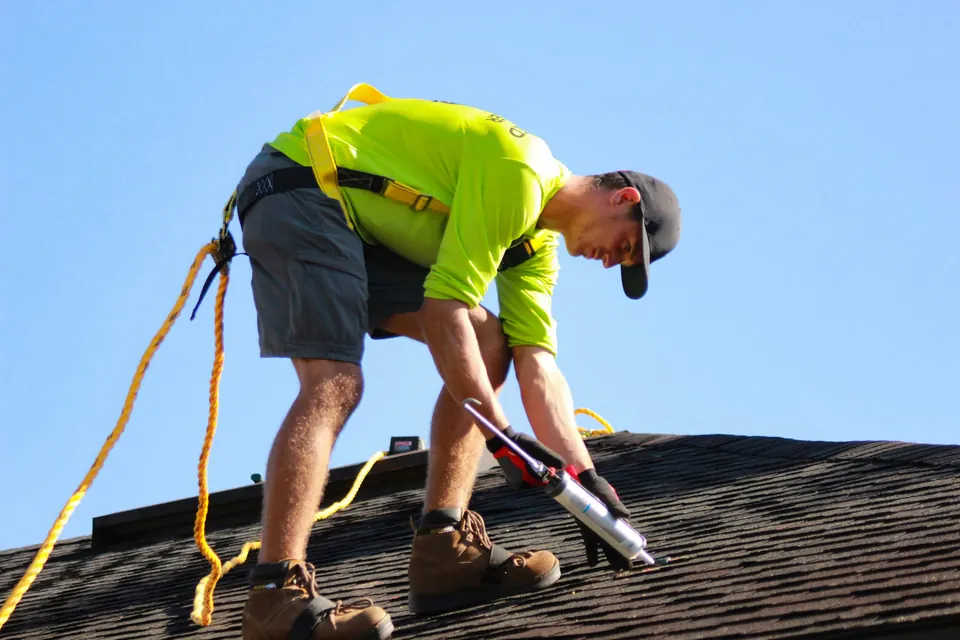
LaRocco names step flashing that was caulked over instead of replaced as a repair it sees often, and says it redoes step, chimney, sidewall and valley flashing in metal rather than sealant. IKO’s guide treats caulk as secondary protection only, for select spots. Alec’s notes that chimney flashing on Long Island is very often the original step flashing with a bead of roof cement smeared over it, and calls that a two-year fix applied ten years ago.
So when the quotes come in, ask whether the price covers new metal or a reseal, and whether the step pieces come out. A roof inspection can pin down which joint is actually leaking before anyone picks up a pry bar.
Local repair prices
County Roofing Systems publishes $200 to $600 for minor flashing repairs and $400 to $2,000 for full flashing replacement. Other Long Island roofers publish their own prices for flashing, chimney flashing, valley leaks and pipe boots, and those sit in our roof repair cost guide, and the chimney repair page compares three contractors on chimney work. We found no Long Island roofer publishing a separate price for a kickout or for step flashing alone. For a leak right now, you can compare Long Island roof repair contractors and request quotes.