
Last reviewed October 31, 2026.
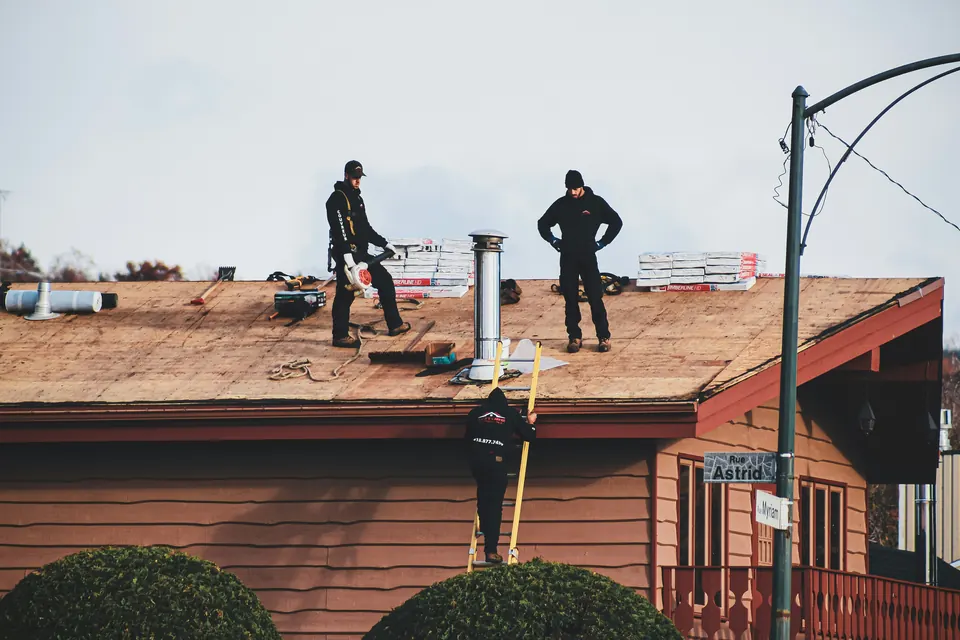
The shingles on a Bay Shore ranch are curling at the edges after twenty-some summers, and the owners have signed with a roofer to tear off and start over in the spring. Before the dumpster arrives, they want to know if Town Hall needs a filing. For a planned reroof with no structural change, Islip says it does not. Storm damage is a different case: the town files repairs in kind after storm, fire or vehicle damage under an emergency repair permit.
What Islip’s permit guide says about roofs
The Town of Islip publishes a two-part list, “When Is a Permit Required?”, most recently revised in June 2025. Under work that needs no permit, for residential roofing, siding and facades, it says: “No permit required for repair or replacement of roof covering, siding or façade unless structural elements are changed.”
The same document draws the lines on the other side:
| Roof work on a house | Permit? |
|---|---|
| Replacing shingles or other roof covering, no structural change | No |
| Changing the roofline | Yes, building permit for an alteration |
| A skylight wider than 15 inches, or any skylight that modifies rafters | Yes |
| A porch roof or roof over | Yes, as an addition |
| Solar panels | Yes, through the state Unified Solar Permit for systems of 25 kW or less |
| Storm, fire or vehicle damage repaired in kind | Yes, a repair damage building permit |
For that last row the guide’s wording is “Replacement in kind/no structural damage only; necessitated by vehicle impact, fire or storm damage.” If the work goes beyond that, it says to file for an alteration instead. The town’s fee schedule prices this as an emergency repair. The guide also says all work still has to meet the state Uniform Code and town code whether or not a permit is required.
Where it gets gray: rafters and new plywood
Neither the guide nor the code defines “structural elements” for a roof. Rafters clearly count, since the guide ties them to skylight permits. Whether replacing rotted plywood sheathing alone crosses the line is not spelled out. If your quote includes more than a few sheets of decking, or any sistering of rafters, email the Building Division at [email protected] and ask before work starts.
When a permit does apply: fees and timing
From the town’s residential fee schedule, effective May 1, 2024:
| Item | Fee |
|---|---|
| Addition or alteration | $220 plus $0.37 per sq ft |
| Emergency repair, non-structural, replaced in kind | $50 per structure |
| Solar panels | $200 |
| Renewal | Half the original fee |
| No-show, failed or skipped inspection | $125 |
| Work done without a permit, less than 4 years ago | 1.5 times the current permit fee |
| Stop-work order before a permit is issued | 3 times the current permit fee |
The base fee is due when the application is accepted, the square-footage fee before the permit is issued, and none of it is refundable. Card payments carry a 3 percent processing fee.
The town’s building permit application lists a one-year term with up to three renewals for residential additions, alterations and emergency repairs. Article IV of the town code says anyone working on the owner’s behalf needs a copy of the written permit, displayed on site whenever work is going on.
Filing, paperwork and inspections
Applications are filed electronically. Some permit types, including emergency repairs, go through the town’s Planning and Development portal at planning.islipny.gov. Others are emailed to [email protected] with documents uploaded separately. The town says a plans examiner and zoning reviewer check a new application for completeness, typically within two business days.
The town’s requirement sheets for other permit types, such as awnings, ask for a survey under one year old, signed and sealed by a licensed surveyor, and a copy of the deed when ownership on the application conflicts with town records. For contractor insurance, the town’s sheets list workers’ compensation on form C-105.2, GSI-105.2 or U-26.3 with the Town of Islip as certificate holder, and disability coverage on DB-120.1 or DB-155, or the CE-200 exemption. They state that ACORD forms are not acceptable proof of either. Confirm the current list for your permit type with a plans examiner.
The residential alterations requirement sheet calls for a minimum of 48 hours’ notice for inspections. The Building Division’s web page says to book them through the Records Office at 631-224-5470 or by email, and that inspectors cannot schedule them. The Records Office closes out the permit with a certificate of occupancy or compliance.
Fines, work hours and landmark areas
Under Section 68-26 of the town code, as amended in 2009, building without a required permit is punishable by a fine not exceeding $2,000, up to 15 days in jail, or both, and each day the violation continues counts as a separate one. The owner and the contractor can each be charged.
Islip’s noise code bars construction or repair that creates a noise disturbance except between 7 a.m. and 8 p.m. on weekdays, apart from urgent necessity or public safety. If a crew proposes a weekend tear-off, ask the Building Division how the town applies that rule first.
Inside a Planned Landmark Preservation district, Section 68-450 says ordinary repairs and maintenance need written approval from the Commissioner of Planning and Development before any work starts, kept on site while the work goes on. A change in appearance needs a certificate of appropriateness from the Planning Board. Ask the Planning Division whether your address is in one.
Villages and the Building Division
Suffolk County lists four incorporated villages inside the Town of Islip: Brightwaters, Islandia, Ocean Beach and Saltaire. Residents there should start with village hall.
For the town, the Building Division is at One Manitton Court, Islip, NY 11751, not at Town Hall on Main Street. It is open Monday to Friday, 8 a.m. to 4 p.m. The division’s web page lists the Permits Office at 631-224-5464, while the town’s permit PDFs list 631-224-5466 for permits and 631-224-5464 for administration. Plans examiners: 631-224-5467. Because of call volume, the town suggests email.
No permit does not mean no rules. The roofer still needs a Suffolk County home improvement license, and the state’s limit of two roof layers still applies. Our Suffolk license guide covers the first and our Brookhaven guide the second.