
Last reviewed October 31, 2026.
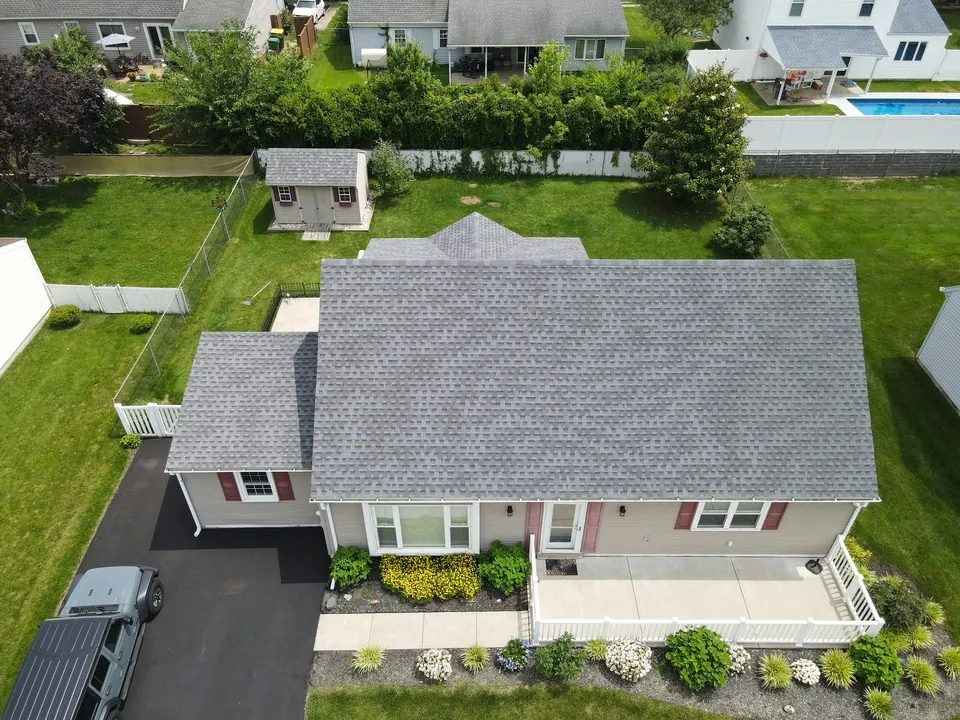
The old roof on a split-level in Massapequa has curled shingles and a soft spot near the chimney, and one of the two estimates on the counter mentions a permit while the other says nothing. Before signing either, the owner wants to know whether the Town of Oyster Bay expects a filing at all. The town’s paperwork gets close to an answer without ever saying it.
What the Oyster Bay code says about a new roof
The current Section 93-15 of the town code makes it unlawful to construct, alter, remove or demolish a building or structure without first getting a building permit from the Division of Building in the Department of Planning and Development. Its only stated exception is for portable tool sheds and other noncommercial storage buildings of 100 square feet or less. A 2016 version of Chapter 93 had a second exception in the same section: “Repairs to buildings or structures may be made without filing an application or obtaining a building permit if no structural alteration is made and if the repairs are in accordance with the provisions of this chapter.” We could not find that sentence in the current text.
The town’s Building Division page lists the kinds of work that need permits, from additions and interior alterations to pools, decks, solar panels and generators. Roofing is not on it. The only roof items are “All patio roofs except canvas” and vestibule covers. It does name “Fire damage repair” and “Change or rearrangement in the structural parts,” so a roof rebuilt after a fire is on the list. The list opens with “include, but are not limited to,” so leaving roofing off is not the same as exempting it.
Put together, a shingle-for-shingle replacement would have fit the 2016 repair exception, but the current code text drops it and no town document addresses reroofing in plain words. Call the Building Division at 516-624-6200 and press 1, describe the job, and note who answered and when.
Tear-off, new sheathing and roofline changes in Oyster Bay
The 2016 repair exception stopped at “structural alteration,” and the code does not define where a roof job crosses that line. Some work clearly changes the structure:
| Roof work on a house | How the town’s papers treat it |
|---|---|
| New shingles on the existing deck, no framing changes | Not named on the permit list; confirm by phone |
| Replacing rotted rafters or adding new framing | A structural alteration, so plan on a permit |
| A raised roofline or a new dormer | An alteration or addition under Section 93-15 |
| A roof over a porch or patio | Listed on the application as “Awning/Roof-over”; patio roofs except canvas are on the permit list |
| Solar panels | On the permit list and eligible for a same-day permit |
| Rebuilding a roof after a fire | “Fire damage repair” is on the permit list |
The application form also asks the owner to swear the property sits “within the unincorporated area of the Town of Oyster Bay,” and the owner’s affidavit and the applicant’s affidavit must both be notarized. A disclosure affidavit is filed with the application as well.
Filing at Town Hall North or Town Hall South
Applications can be downloaded from the town’s forms page or picked up at either office: Town Hall North, 74 Audrey Avenue, Oyster Bay, NY 11771, or the Building Division annex at Town Hall South, 977 Hicksville Road, Massapequa, NY 11758. The town offers same-day permits at both for a set list of projects, such as pools, fences, water heaters, solar panels and generators. Roofing jobs are not on that list.
For new construction, the Building Division says an application generally needs a copy of the survey and two copies of the construction plan. Once the contractor is chosen, the town’s submission form has the owner and the contractor each sign before a notary and attach or confirm the contractor’s insurance.
The town’s insurance sheet, revised October 2023, accepts only forms CE-200, C-105.2, U-26.3 and GSI-105.2 as proof of workers’ compensation, says ACORD forms are not acceptable, and wants the Town of Oyster Bay at 74 Audrey Avenue listed as certificate holder. For residential construction it also asks for a copy of the general contractor’s Nassau County home improvement license. Our Nassau license guide shows how to look that license up yourself.
Oyster Bay permit fees and the clock on a permit
The code does not print dollar amounts. In a 2016 version of Section 93-22, fees are based on the cost of the improvements as determined by the Means Square Foot Manual, in amounts set by a fee schedule the Commissioner of Planning and Development establishes, with a minimum nonreturnable fee for every application. We could not confirm that wording in the current code and found no posted copy of the schedule on the town’s site, so ask for the number when you call.
The time limits are in the current Section 93-24:
| Rule | Section 93-24 |
|---|---|
| Starting work | Within six months of issue, or the permit expires |
| Finishing | Work concluded and a certificate of occupancy obtained within one year |
| Renewal | Before expiration, where good cause is shown, at the scheduled fee |
| After expiration | The permit is void, and the town can order work done under it removed |
A 2016 version of Section 93-26 also asked that a copy of the permit be fixed to the building where it can be seen from the street, or displayed at an approved spot on site, with the approved plans kept there until the work was done. We could not confirm that rule in the current code, so ask the Building Division what it expects on site.
Flood zones and landmarks in the Town of Oyster Bay
Chapter 121 of the town code covers flood damage prevention for the town’s special flood hazard areas, Community Number 360483, and the flood maps are kept at Town Hall. It treats any reconstruction, rehabilitation or other improvement costing 50 percent or more of the structure’s market value as a substantial improvement, a category that also takes in substantially damaged buildings. If a new roof is part of a larger rebuild on the bay or near the south shore, raise the flood question at the same time as the permit question.
Chapter 143, adopted in 1974, sets up the town’s Landmarks Preservation Commission and has sections on building permits and on the alteration of landmarks. If your house is a designated town landmark, ask Planning and Development whether the commission needs to see the roof before work starts.
Fifteen Oyster Bay villages that issue their own permits
Nassau County lists 15 incorporated villages in the Town of Oyster Bay: Bayville, Brookville, Centre Island, Cove Neck, Farmingdale, Lattingtown, Laurel Hollow, Massapequa Park, Matinecock, Mill Neck, Muttontown, Old Brookville, Oyster Bay Cove, Sea Cliff and Upper Brookville. The town’s application covers only the unincorporated area, so homes in those villages go through village hall.
Hamlets such as Massapequa, Hicksville, Syosset and Plainview are not on the county’s village list, so they stay with the town. Neighbors on the Hempstead side of the line deal with a different code, which our Hempstead guide walks through.