Last reviewed October 31, 2026.
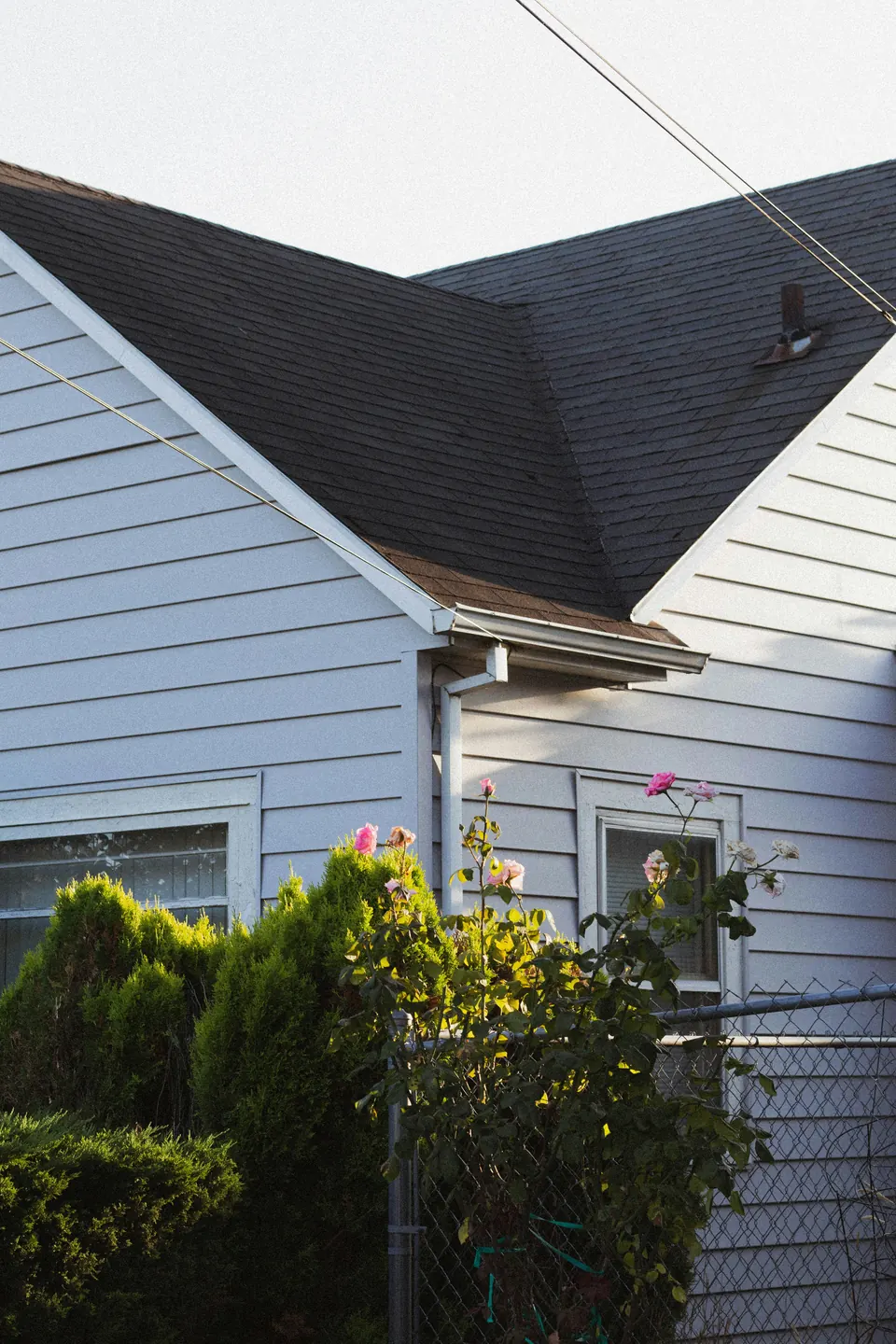
A thunderstorm rolls through on a July afternoon. From the kitchen window you watch the back gutter, the one under the valley where two roof slopes meet, sheet water over its front lip. The downspout at the corner gurgles and keeps up with nothing.
The installer coming next week will ask whether you want 5-inch or 6-inch. You can work out the answer from three things: how hard it rains here, how much roof drains into that run, and what the downspout can swallow.
How hard it rains here, in numbers
NOAA Atlas 14 (Volume 10, Version 3) publishes rainfall intensity for any point on Long Island. We pulled two points on October 31, 2026: one near Mineola, one in central Suffolk near Central Islip. Intensity is a rate. A 5-minute figure of 7.8 inches per hour means rain falling that fast for those five minutes.
| Storm | Near Mineola (40.74 N, 73.64 W) | Central Suffolk (40.79 N, 73.20 W) |
|---|---|---|
| 5 minutes, 10-year storm | 7.91 in/hr | 7.80 in/hr |
| 5 minutes, 100-year storm | 12.1 in/hr | 12.0 in/hr |
| 60 minutes, 10-year storm | 1.92 in/hr | 1.98 in/hr |
| 60 minutes, 100-year storm | 2.95 in/hr | 3.04 in/hr |
Look down the columns. The short bursts run about four times the hourly rate, and that gap is why two honest sizing methods can give different answers.
Two sizing methods, two different storms
The 2025 Plumbing Code of New York State, Section 1106.1, bases leader and storm drain sizes on the 100-year hourly rainfall rate from the code’s NOAA map or from approved local weather data. On Long Island that is about 3 inches per hour, going by the Atlas 14 numbers above.
The Sheet Metal and Air Conditioning Contractors’ National Association takes the stricter view. Its online downspout and gutter sizing calculator, built on the Architectural Sheet Metal Manual, uses a 5-minute duration for a 10-year or 100-year storm. It points users to NOAA’s precipitation frequency website for current local values. Size a gutter that way and it holds through the hardest few minutes of a storm, not just the average hour.
Working out the flow off one roof slope
The state code turns rain into flow with one line, Equation 11-1. Gallons per minute equals rainfall in inches per hour, times roof area in square feet, times 0.0104.
J&M Gutter Tech, a Long Island gutter company, measures each roof plane’s footprint from eave to ridge, adds the overhang, then multiplies by a pitch factor. It says runoff from roofs under 4/12 is much less aggressive (February 2026):
| Roof pitch | J&M Gutter Tech factor |
|---|---|
| Under 4/12 | 1.0 |
| 4/12 to 5/12 | 1.05 |
| 6/12 to 7/12 | 1.10 |
| 8/12 to 9/12 | 1.20 |
| 10/12 to 12/12 | 1.30 |
Now run 1,000 square feet of design area through the code equation. At the 100-year hourly rate of 3.04 inches per hour, about 32 gallons a minute pour into the gutter. At the 10-year, 5-minute rate of 7.80, that climbs to about 81. At the 100-year, 5-minute rate of 12.0, it hits about 125.
The state code’s gutter table for 5 and 6 inches
Table 1106.6 of the 2025 state plumbing code lists gutter capacity in gallons per minute. A 5-inch half-round gutter pitched 1/8 inch per foot is rated at 74 gallons a minute, and a 6-inch half-round at the same pitch at 110.
Set those against the flows above. At the hourly rate, a 1,000 square foot design area clears a 5-inch gutter easily. In a 10-year, 5-minute burst, its 81 gallons a minute overruns the 5-inch rating and sits well inside the 6-inch one.
One catch: the table covers half-round shapes and listed rectangular sizes, not the K-style profile. Ask the installer for the manufacturer’s rating on the exact gutter going up.
Downspouts set the real limit
Table 1106.3 of the same code rates a 3-inch round leader at 92 gallons a minute and a 4-inch round at 192. The common 2x3 and 3x4 rectangular downspouts are not listed by name. The nearest listed sizes are 2 1/2 by 3 inches, rated at 92, and 3 by 4 1/4 inches, rated at 192.
Long Island installers agree the bigger downspout carries far more. They split on how much more. J&M Gutter Tech says a 3x4 has more than double the drainage capacity of a 2x3. LI Gutter Service says the upgrade adds 50 percent more capacity.
J&M also says a valley may need a 3x4 or even a 4x5 downspout at or near its end, because one gutter section takes the water off two roof planes. How many downspouts a run needs, and what each costs, is on our gutter installation cost guide.
When Long Island installers say go to 6 inch
J&M Gutter Tech treats 5-inch as enough for smaller homes with simple, low-pitched roofs. It recommends 6-inch for most homes in its area, especially big roofs, steep pitches and houses exposed to intense downpours, and suggests 6-inch with leaf guards on wooded lots. LI Gutter Service is more conservative, calling the step up worth it for chronic overflow or heavy tree cover (April 2026).
Before you sign, ask the installer three things: which roof planes feed each run, what pitch factor and rainfall rate they used, and which downspout size goes with the gutter. Where the water lands after it leaves the downspout is its own question, covered in our guide to downspouts and dry wells. For materials and contractors, start at our gutter installation page.