Last reviewed October 31, 2026.
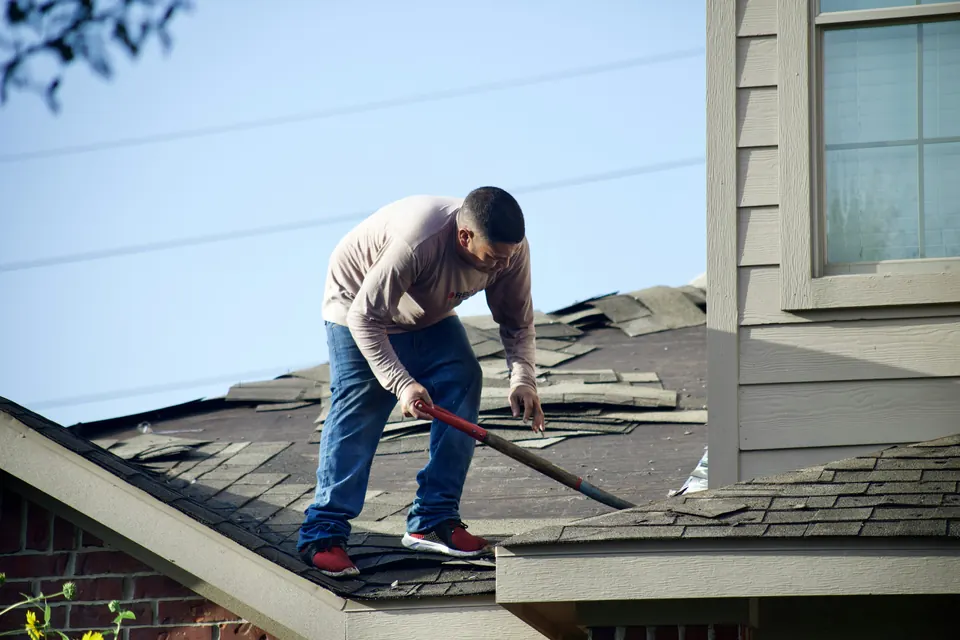
The crew peels the first row of shingles off a Floral Park colonial, and the boards along the eave come up soft and dark. Whether that job needed a village permit before anyone climbed the ladder comes down to the wood, and how much of it was always going to be replaced.
The sheathing line on Floral Park’s permit sheet
The village Department of Buildings keeps a one-page sheet called “When Do I Need a Permit?” (revised May 16, 2024). Its opening rule is broad. A permit is required for any work that must conform to the state Uniform Code or the village code, including the alteration, improvement or removal of any building or portion of one.
Then it gets specific. Under new, replacement or major repair work, two roofing lines appear: “Roof Replacement - All Commercial” and “Roof Replacement - Residential involving sheathing replacement.” Dormers, chimneys and structural repair share the list.
Repairs are exempt, the sheet says, when they leave load-bearing parts, egress, building systems and fire protection alone. What it never puts in writing is that a house reroof keeping every board is exempt. The village’s own roof form has boxes for full and partial replacements, plus a yes or no question on whether sheathing is being replaced.
The Building Department page has one line worth taking literally: call 516-326-6319 “before you make any changes to your property.”
| Roof work on a Floral Park house | What the village sheet says |
|---|---|
| Replacement with new sheathing | Permit required |
| New dormer | Permit required |
| New or replaced chimney | Permit required |
| Commercial roof replacement | Permit required |
| Shingles replaced, sheathing kept | Not stated, so call first |
Inside the village roof permit form
Floral Park keeps its own Roof Permit Application for Residential Properties (revised January 2021). It wants one signed copy with the owner’s authorization notarized, the permit fee and a Nassau County Department of Assessment form. Incomplete applications, it warns, will not be accepted.
The questions get into the roof itself: the roof type, whether underlayment, ice shield and flashing are going in, whether the old roof comes off down to the sheathing and, if not, how many layers are already up there. If the new roof changes the weight, the form requires a letter from a New York State licensed architect or engineer certifying that the rafters can carry it.
Three inspections are listed on the form: sheathing, flashing and ice shield, and final. Work stays exposed until each one is approved, and the permit goes up where it can be seen from the street.
Online permitting is “coming soon,” according to the Building Department page. For now, applications go to the department at One Pool and Garage Road (the GPS address is 124 Stewart Street). The permit sheet says questions are answered from 8:30 a.m. to 4:30 p.m., Monday to Friday.
Floral Park roof fees after June 2026
The fee schedule that took effect June 1, 2026 sets the numbers:
| Item | Fee |
|---|---|
| Residential roof | $150 flat |
| Commercial roof | General building permit structure, $500 for the first $1,000 plus $15 per added $1,000 |
| Permit renewal | 50 percent of the permit fee for each six month renewal |
| Dumpster on the property | $50 initial, $10 weekly renewal |
| Dumpster on a residential street, non-metered | $50 initial, $50 weekly renewal |
One loose end: the schedule also lists a $50 filing fee under building permits without saying whether it applies to a roof filing. Ask when you submit.
How long a Floral Park roof permit lasts
The roof form’s printed conditions give a permit six months if construction has not started, and 12 months from the date of issuance once it has. Let it expire and the job waits on a renewal application, updated drawings and the fee.
If plans change mid-job, the department has to hear about the field change before it happens, and work stops until an amended permit is approved.
Crews can work Monday to Saturday, 8 a.m. to 7 p.m., excluding holidays, under the construction hours in the village license application.
A village contractor license on top of Nassau’s
Chapter 37A of the village code is plain about it: no one may work at home improvement or contracting inside the village without a village license. The roof form backs that up by asking for the contractor’s Floral Park license number.
The 2026 license application (revised July 22, 2026) asks residential contractors for a copy of a current Nassau County Consumer Affairs license, workers’ compensation and disability certificates, and liability coverage of at least $1,000,000 per occurrence and $2,000,000 in aggregate. A new village license costs $75 and a renewal $50. The current one expires December 31, 2026.
Homeowners doing the work themselves check a waiver box on the roof form, and the license packet asks them for a BP-1 affidavit and proof of homeowners insurance.
Our Nassau County license guide covers checking the county number.
Fines, legalization and the Architectural Review Board
Section 99-63 of the village zoning code (the ecode360 version printed August 24, 2026) makes building, altering or using a structure without a building permit the chapter requires an offense. A first conviction is punishable by a fine of up to $350 or up to 15 days in jail. A second within five years runs $350 to $700, and a third $700 to $1,000. Every week the violation continues counts as a separate one.
Contractors carry their own risk. The license packet says those who repeatedly work without permits may not be considered for renewal. Legalizing finished residential work costs the permit fee plus a $100 existing conditions survey fee under the June 2026 schedule.
Then there is the Architectural and Preliminary Site Plan Review Board. The Building Department page says some alterations may need its approval for aesthetic purposes before a permit can be issued, and Section 99-53 lets the board weigh exterior design and neighborhood character.
We found no village rule sending a like-for-like reroof to the board. The permit sheet does list residential facade work that changes material type or architectural features, though, so ask before trading shingles for metal or tile.
A village split between Hempstead and North Hempstead
Floral Park shows up under two different towns depending on which list you read. Nassau County files it, and the separate Village of South Floral Park, under the Town of Hempstead. The Town of North Hempstead puts Floral Park on its own list of incorporated villages.
For a house inside village limits, the permit comes from the village, not from either town. The roof form asks for section, block and lot, and the owner signs that the property is within the Incorporated Village of Floral Park. If the house turns out to be outside, our Hempstead and North Hempstead guides cover the town rules.